
What Our Customers Are Saying
VAV Box Explained: How Variable Air Volume Systems Control Airflow
1
Oct
Table of Contents:
- What Is a VAV System
- How a VAV Box Works
- What Is a VAV System
- How a VAV Box Works
- Single Duct versus Fan Powered VAV Boxes
- VAV Reheat
- How a VAV System Connects to a BMS
- Common VAV Applications
- Frequently Asked Questions
A VAV box, short for variable air volume box, adjusts the amount of conditioned air delivered to a room to match actual demand, rather than supplying a fixed volume regardless of need. This makes VAV systems significantly more efficient than constant volume alternatives in buildings with varying occupancy and load across different zones.
What Is a VAV System
A variable air volume system supplies air at a constant temperature from a central AHU, then adjusts how much of that air each zone actually receives using a VAV box local to that zone. This is the opposite approach to a constant volume system, which supplies a fixed volume of air and instead varies its temperature to match demand.
How a VAV Box Works
Inside a VAV box, a damper adjusts the size of the air path, an airflow sensor measures the actual volume passing through, and a local controller continuously adjusts the damper position to hit a target airflow set by the BMS. This closed loop arrangement, similar in principle to the wider BMS control loop covered in our BMS in HVAC guide, allows each zone to receive exactly the airflow it needs at any given moment.
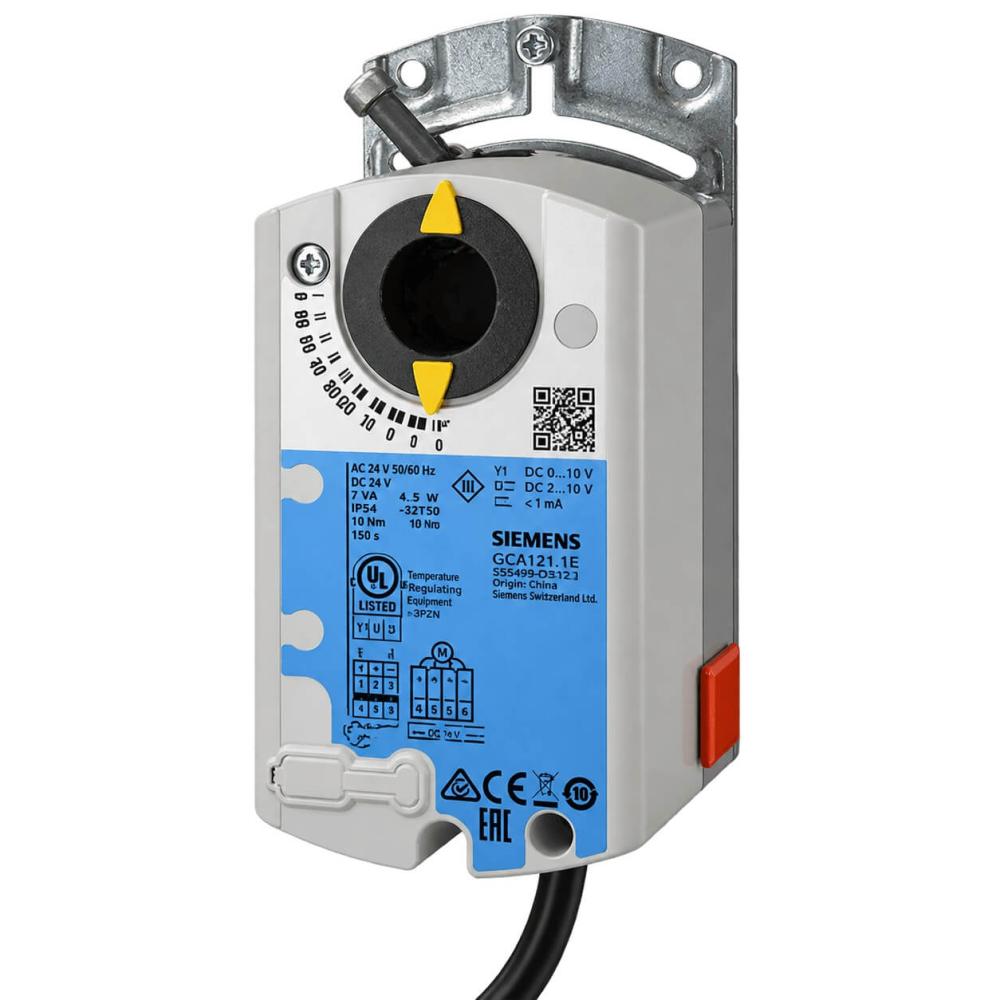
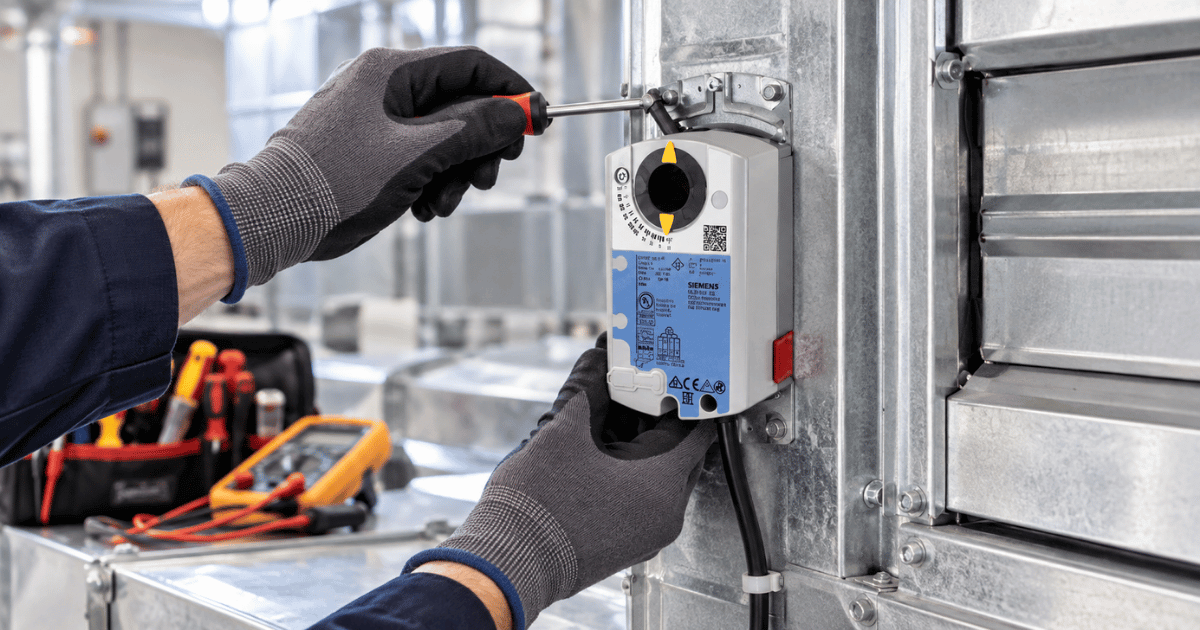
Siemens GLB181.1E VAV compact controller range packages this damper, sensor, and controller combination into a single unit, available with Modbus, BACnet or KNX communication depending on the BMS integration required. Shop Belimo VAV compact controllers
A VAV box, short for variable air volume box, adjusts the amount of conditioned air delivered to a room to match actual demand, rather than supplying a fixed volume regardless of need. This makes VAV systems significantly more efficient than constant volume alternatives in buildings with varying occupancy and load across different zones.
What Is a VAV System
A variable air volume system supplies air at a constant temperature from a central AHU, then adjusts how much of that air each zone actually receives using a VAV box local to that zone. This is the opposite approach to a constant volume system, which supplies a fixed volume of air and instead varies its temperature to match demand.
How a VAV Box Works
Inside a VAV box, a damper adjusts the size of the air path, an airflow sensor measures the actual volume passing through, and a local controller continuously adjusts the damper position to hit a target airflow set by the BMS. This closed loop arrangement, similar in principle to the wider BMS control loop covered in our BMS in HVAC guide, allows each zone to receive exactly the airflow it needs at any given moment.
Siemens GLB181.1E VAV compact controller range packages this damper, sensor, and controller combination into a single unit, available with Modbus, BACnet or KNX communication depending on the BMS integration required. Shop Belimo VAV compact controllers
Single Duct versus Fan Powered VAV Boxes
A single duct VAV box simply modulates the volume of centrally conditioned air reaching the zone. A fan powered VAV box adds a local fan, either drawing in additional air from the ceiling void or boosting airflow at low central supply volumes, useful in perimeter zones with higher heating demand.
VAV Reheat
A VAV reheat box adds a heating coil after the damper, allowing the box to reheat air locally for zones, typically perimeter offices, that need heating even while the central AHU is supplying cool air to the rest of the building.
How a VAV System Connects to a BMS
The BMS sends airflow set points to each VAV box based on zone temperature demand, and each box's local controller works to hit that target continuously, reporting actual airflow back to the central system for monitoring and fault detection.
Common VAV Applications
Variable Air Volume (VAV) systems are highly suitable for office spaces that have different occupancy levels during the day, multi-tenant buildings that have different tenants with different schedules, and schools which have zoned areas where different classes are scheduled throughout the week.
Frequently Asked Questions
What is the difference between VAV and constant volume systems?
A VAV system varies the volume of air delivered to match demand at a constant supply temperature, while a constant volume system delivers a fixed air volume and instead varies the supply temperature.
What does a VAV controller do?
The VAV controller adjusts the damper position within the box to hit a target airflow set by the BMS, using feedback from a local airflow sensor.
What is a typical VAV airflow range?
This varies significantly by box size and application, but VAV boxes typically modulate between a minimum airflow, set to maintain ventilation, and a maximum airflow sized to the zone's peak cooling load.
Browse VAV dampers, actuators and airflow sensors at iACS Store.
Comment(s)
Recent Posts
-
EC Fans versus AC Fans Explained: Which Is Right for Your HVAC System
 October 17, 2026
 -
Steam Humidifier Explained: How HygroMatik Humidification Systems Work
 October 16, 2026
 -
Carel Controller Fault Codes Explained: A Troubleshooting Guide
 October 15, 2026
 -
Damper Actuator Not Working? How to Diagnose and Fix Common Faults
 October 2, 2026
 -
VAV Box Explained: How Variable Air Volume Systems Control Airflow
 October 1, 2026