
What Our Customers Are Saying
PT100 Temperature Sensor Explained: How It Works, Types and Wiring
7
Sep
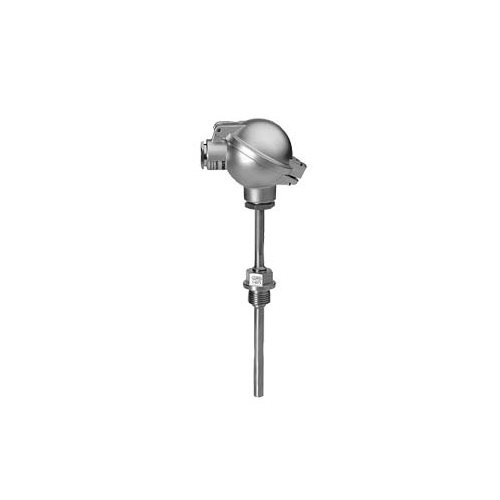
A PT100 temperature detector is a resistance temperature detector that consists of platinum with a resistance of 100 ohms at zero degrees Celsius and exhibits predictable changes in resistance with changes in temperature. PT100 temperature detectors are among the most accurate means of temperature measurement.
PT100 Sensor Definition
A PT100 sensor operates based on a simple physical phenomenon: the resistance of platinum varies with its temperature in a predictable manner. In this way, the temperature of the object can be measured by measuring the resistance of platinum. Its name is based on this physical phenomenon since the resistance of platinum at zero degrees centigrade is 100 ohms.
PT100 Temperature Sensors: How They Work
The Wheatstone bridge configuration is commonly employed in order to detect the tiny changes in resistance, which will be converted into a voltage signal which the control system can use. The number of wires needed for connecting the temperature probe will influence the accuracy, since the two-wire configuration also takes into account the resistance of the cable. A three wire connection compensates for cable resistance and is the most common configuration in commercial HVAC. A four wire connection removes cable resistance error almost entirely and is used where the highest accuracy is required.
Comparison of PT100 with PT1000
In the case of PT1000 sensors, both operate by the same principle except that PT1000 sensors have resistance equal to 1000 ohms in zero-degree conditions compared to 100 ohms in the case of PT100. The reason for having high resistance is because of reduced cable resistance in relation to total resistance in case of long cable distance, but it does not necessarily mean that PT1000 is more precise in its measurements than PT100.
Types of PT100 Sensors for HVAC
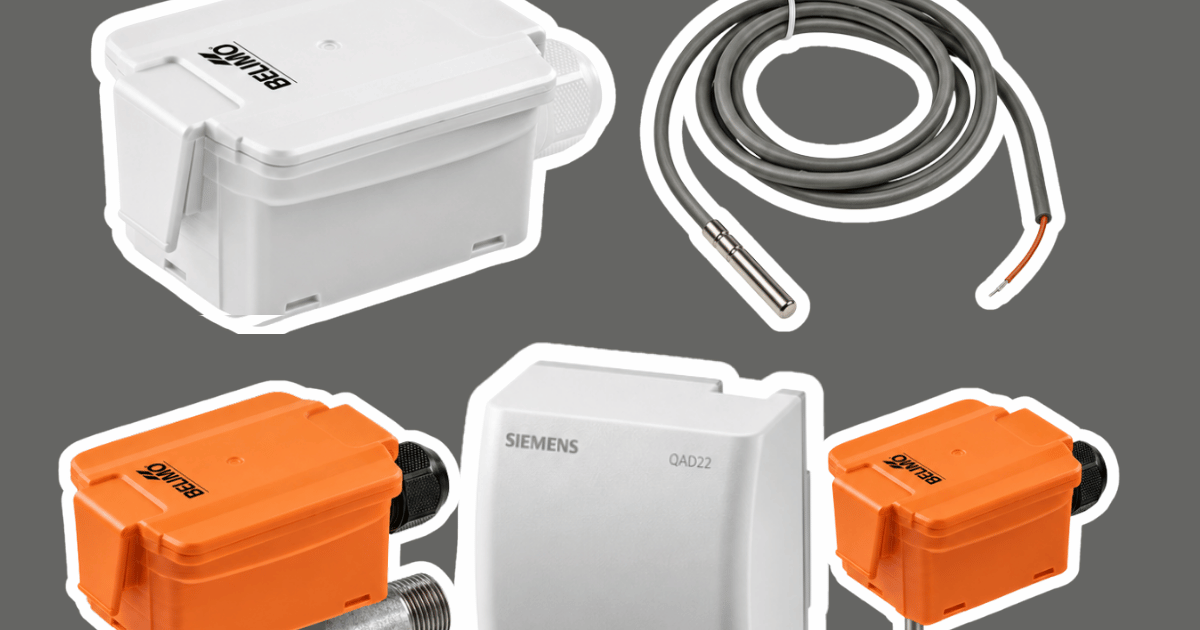
Immersion sensors fit directly into a pipe using a pocket, giving the most accurate reading of the fluid itself, as covered further in our immersion versus strap on sensor guide. Surface mount sensors clamp to the outside of a pipe or duct where drilling into the system is not practical. Room temperature sensors read air temperature within the occupied space. Outdoor sensors measure ambient conditions and are commonly used as the input for weather compensation strategies.
PT100 Wiring Guide
Two wire, three wire and four wire connections each require the corresponding number of terminals at both the sensor and the controller end, and mixing wiring types is one of the most common causes of an inaccurate reading after installation. When connecting a PT100 into a BMS or controller, always confirm the controller's input is configured for the correct wiring type before commissioning, since a controller expecting a three wire input will misread a two wire sensor.
PT100 Sensor Specifications to Check When Buying
Temperature range needs to comfortably cover the application, with margin either side of the expected operating range. Accuracy class, either Class A or Class B under the relevant standard, determines how tightly the sensor's reading is guaranteed to match true temperature. IP rating, covered in detail in our IP ratings guide, determines suitability for outdoor or washdown locations. The probe length should fit the pipe or duct into which it is going to be inserted, especially for immersion probes since a short probe cannot reach the centre of the flow path.
Frequently Asked Questions
What is the difference between a PT100 and a thermistor?
PT100 is a resistance temperature detector based on platinum, providing good accuracy and stability over a wide range of temperatures, whereas a thermistor is an inexpensive semiconductor device that provides better accuracy within a limited range but poor stability.
How accurate is a PT100 sensor?
Class A PT100 sensors are typically accurate to within a fraction of a degree Celsius, while Class B sensors have a slightly wider tolerance, both figures specified against the relevant international standard.
Can I use a PT100 with my BMS controller?
Yes, provided the controller has an input configured for the correct PT100 wiring type, either two wire, three wire or four wire, matching the sensor being connected.
What does a PT100 sensor measure?
A PT100 sensor measures temperature, commonly of pipe fluid, duct air, room air or outdoor air, depending on which type of PT100 sensor is fitted.
PT100 Sensors Available at iACS
Siemens supplies one of the broadest PT100 ranges on iACS, covering immersion sensors such as the QAE2111.015 with a 150mm probe, the QAC2010 outdoor sensor for weather compensation strategies, and the QAM2110.040 duct sensor with a 400mm probe.
Belimo's PT100 range is built around simplicity of wiring, with the 01CT-1AH cable sensor and 01HT-1A contact sensor both suited to retrofit work where a rigid probe is not practical.
Sontay also stocks flying lead and remote probe PT100 sensors, including the TT-555-D, a low-cost option where space around the sensing point is tight.
Browse PT100 and temperature sensors for HVAC at iACS Store.
Comment(s)
Recent Posts
-
EC Fans versus AC Fans Explained: Which Is Right for Your HVAC System
 October 17, 2026
 -
Steam Humidifier Explained: How HygroMatik Humidification Systems Work
 October 16, 2026
 -
Carel Controller Fault Codes Explained: A Troubleshooting Guide
 October 15, 2026
 -
Damper Actuator Not Working? How to Diagnose and Fix Common Faults
 October 2, 2026
 -
VAV Box Explained: How Variable Air Volume Systems Control Airflow
 October 1, 2026