
What Our Customers Are Saying
Thyristors and Solid State Relays in HVAC: A Technical Guide
4
May
Thyristor power controllers and solid state relays (SSRs) are the preferred method of controlling resistive heating loads in HVAC applications — from AHU electric heating coils and duct heaters to humidifier heating elements and heat trace systems. They offer smooth, stepless power control without the mechanical wear and contact bounce associated with electromechanical contactors. These technologies form an important part of modern HVAC control strategies, as outlined in The Complete Guide to HVAC Controls.
What Is a Thyristor?
A thyristor (specifically an SCR — silicon controlled rectifier, or a TRIAC for AC applications) is a semiconductor switch that controls the flow of current by varying the point in each AC cycle at which conduction begins. By advancing or retarding the firing angle, the thyristor varies the proportion of each half-cycle that is conducted to the load — and therefore the average power delivered.
This phase-angle control method allows smooth, continuous variation of power from 0% to 100% without switching noise and without the step changes that contactors produce. For electric heating elements — which are resistive and therefore do not generate starting surges — phase-angle control is ideal.
What Is a Solid State Relay (SSR)?
A solid state relay power controller is a semiconductor switching device that turns a load fully on or fully off — unlike a thyristor power controller which varies output continuously. SSRs use either zero-crossing switching (turns on at a zero-crossing of the AC waveform, minimising switching transients) or random-phase switching.
For temperature control applications, SSRs are used with time-proportional outputs from the controller — the controller switches the SSR on and off at a fixed cycle time (typically 1–30 seconds) and varies the on/off ratio to modulate average power. This is simpler and lower-cost than full phase-angle control, but is not suitable for applications that are sensitive to thermal cycling or where the load radiates RF interference during switching.
Single Phase vs Three Phase
For smaller single‑phase loads — such as duct heaters, individual heating elements, and humidifier cylinders up to roughly 4 kW — single‑phase thyristors or SSRs provide smooth proportional control with minimal installation complexity. You can browse 1‑phase power controllers to view suitable options for these applications.
Larger heating loads require three‑phase control, where three‑phase thyristor controllers modulate all phases simultaneously to deliver stable, balanced power. These units are available in star or delta configurations depending on the heater design and supply arrangement. For higher‑capacity systems, you can browse 3‑phase power controllers to review available models.
HVAC Applications
- AHU electric pre-heat and re-heat coils — thyristor controllers provide smooth supply air temperature modulation without the step changes that contactors produce.
- Humidifier cylinder control — Carel humiSteam and heaterSteam humidifiers use integrated thyristor control to modulate immersed electrode or resistance element output.
- Duct heater control — frost protection and supplementary heating in air handling systems.
- Heat trace — pipe and duct trace heating in frost-risk locations
For motor‑driven loads, inverter‑based control may be more appropriate, as outlined in the Variable Speed Drives — Alternative for Motor Loads guide.
Key Selection Parameters
- Load current — select a thyristor or SSR with a continuous current rating at least 25% above the load current to allow for derating at elevated ambient temperature.
- Voltage rating — UK single-phase loads operate at AC 230V; three-phase at 400V. The device voltage rating must exceed the supply voltage by a safety margin.
- Control signal — most thyristor controllers accept a 0–10V or 4–20mA proportional signal from the HVAC controller.
- Heatsinking — thyristors generate significant heat and require adequate heatsinking or forced air cooling. Check the derating curves for the installation environment temperature.
For available models across both single‑phase and three‑phase applications, you can browse power controllers in the iACS product range. For a wider context on how these devices fit into modern HVAC control strategies, return to The Complete Guide to HVAC Controls.
Comment(s)
Recent Posts
-
Steam Humidifier Explained: How HygroMatik Humidification Systems Work
 October 16, 2026
 -
Carel Controller Fault Codes Explained: A Troubleshooting Guide
 October 15, 2026
 -
Damper Actuator Not Working? How to Diagnose and Fix Common Faults
 October 2, 2026
 -
VAV Box Explained: How Variable Air Volume Systems Control Airflow
 October 1, 2026
 -
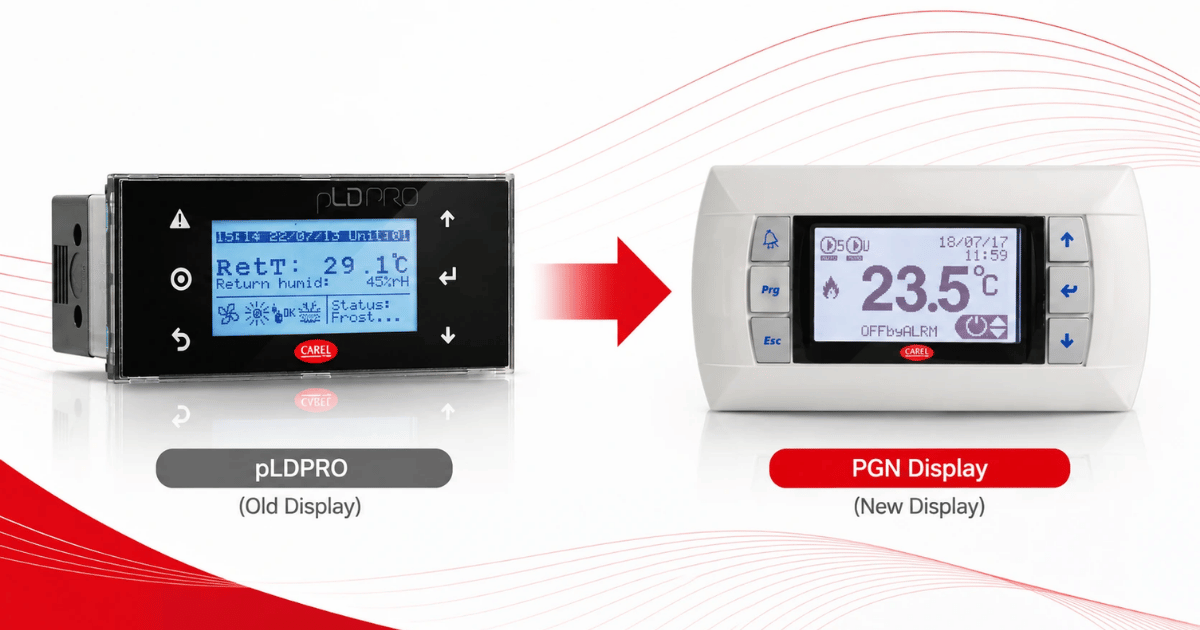
Replacing a CAREL pLDPRO Display: pGDn Options, Fit Checks and Affected Part Numbers
 September 23, 2026