
What Our Customers Are Saying
HVAC Actuators: The Complete Technical Guide for Engineers
6
May

Table of Contents
- What Is an Actuator and What Does It Do in HVAC?
- What Does an HVAC Control System Do?
- The Key Components of an HVAC Control System
- How HVAC Controls Communicate
- What Is a Building Management System (BMS)?
- How to Select HVAC Controls for Your Application
- Common HVAC Controls Problems and How to Avoid Them
- iACS HVAC Controls Range
- Frequently Asked Questions
Actuators are the physical output devices of every HVAC control system. When a controller decides that a damper needs to open or a valve needs to modulate, it is the actuator that makes it happen — converting a low-voltage electrical signal into precisely calibrated mechanical movement. Selecting the wrong actuator is one of the most common causes of poor HVAC control, noisy operation, and premature mechanical failure.
This guide covers every aspect of HVAC actuator selection and application: types, specifications, sizing, installation, and the key differences between the leading ranges from Belimo and Siemens. iACS stocks both brands comprehensively, and our technical team advises engineers on actuator selection every day.
What Is an Actuator and What Does It Do in HVAC?
An HVAC actuator is an electromechanical device that converts a controller's electrical output signal into rotary or linear mechanical movement to open, close, or modulate a valve or damper. The actuator receives a signal — on/off, 3-point floating, or proportional analogue (0–10V or 4–20mA) — and moves its output shaft to the corresponding position.
The two primary HVAC actuator applications are:
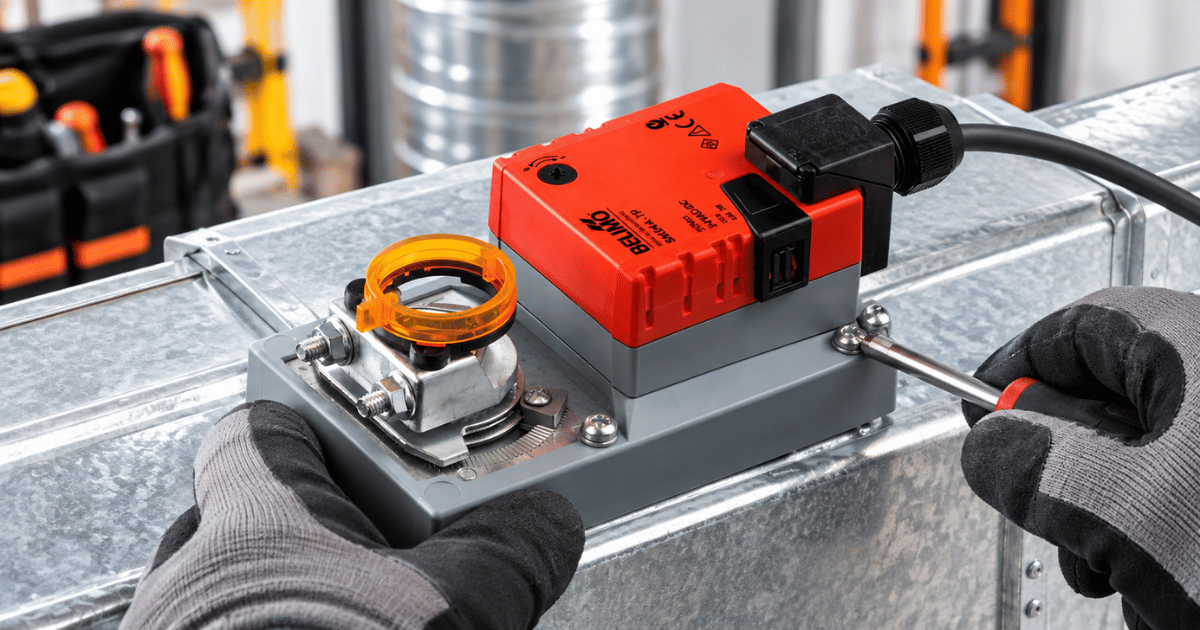
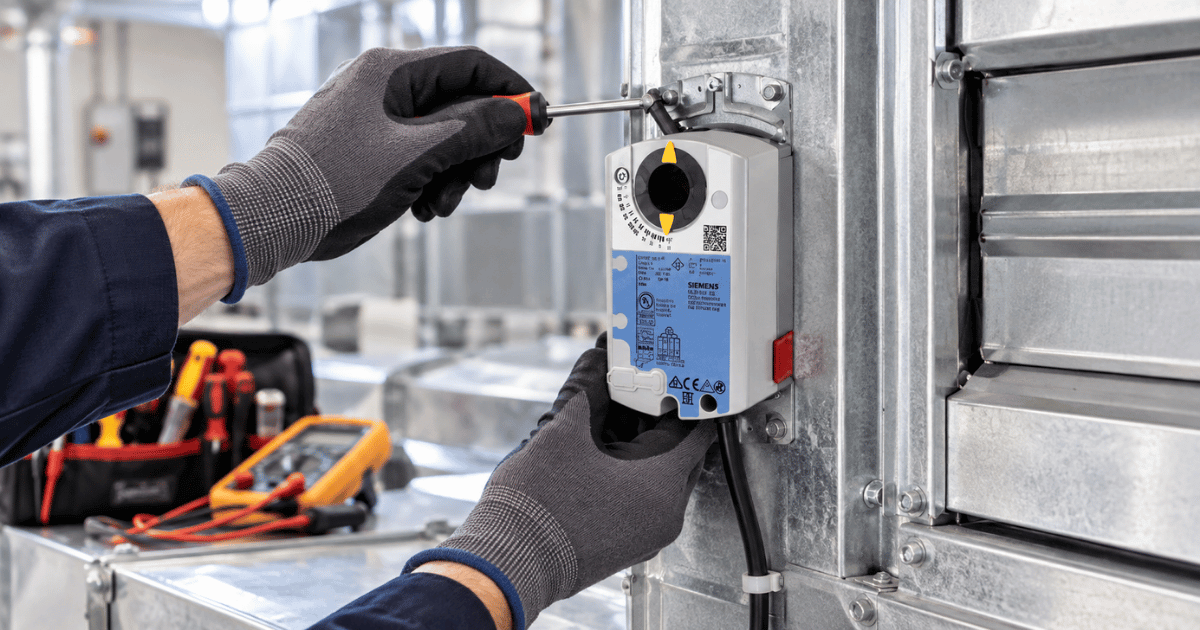
- Damper actuators — mounted to air damper shafts in ductwork. They open and close damper blades to control airflow. Applications include: mixed air dampers in AHUs, VAV box actuators, smoke/fire damper actuators, outside air intake dampers, and bypass dampers.
- Valve actuators — mounted to water control valves. They modulate the flow of hot water, chilled water, or condenser water through coils, heat exchangers, and terminal units. Applications include: AHU heating and cooling coil control, fan coil unit (FCU) valve control, heat interface unit (HIU) control, and district heating applications.
What Does an HVAC Control System Do?
An HVAC control system manages the behaviour of mechanical equipment — fans, pumps, coils, humidifiers, chillers — by reading inputs from sensors and sending outputs to actuators and other devices. The core loop is always the same:
- A sensor measures a condition — temperature, humidity, pressure, CO₂ level, or flow rate.
- The controller compares the measured value against a setpoint (the desired condition).
- If there is a difference (an error), the controller sends a corrective signal to an output device.
- The output device — an actuator opening a valve, a drive changing fan speed — adjusts the system.
- The sensor continues measuring, and the loop repeats continuously.
This is closed-loop control, and it underpins every modern HVAC system. The sophistication lies in how fast the controller responds, how it anticipates changes, and how it balances multiple zones and demands simultaneously.
The Key Components of an HVAC Control System
Every HVAC control system, however simple or complex, consists of the same fundamental component types. Understanding each one is essential for specification, commissioning, and fault-finding.
Sensors and Transmitters
Sensors are the eyes and ears of the control system. Without accurate sensor inputs, no controller can maintain setpoints. The most common sensor types in HVAC are:
- Temperature sensors — NTC thermistors, Pt1000 thermistor, and Pt1000 elements are the most common. Space-mount sensors monitor room conditions; duct sensors monitor air supply and extract temperatures; immersion sensors monitor pipework. Sontay produce one of the most comprehensive ranges available in the UK.
- Humidity sensors — measure relative humidity, often combined with temperature in a single unit. Temperature humidity sensors are critical for comfort control, humidification systems, and condensation prevention.
- Pressure sensors and differential pressure gauges — used to monitor duct static pressure, filter condition, pump head, and fluid pressure in pipework.
- CO₂ and air quality sensors — used for demand-controlled ventilation, measuring occupancy levels by proxy.
- Flow meters and energy meters — for BTU monitoring, heat metering, and system balancing.
Controllers
The controller is the brain of the system. It receives inputs from sensors, runs control algorithms, and generates output signals. Controllers range from simple single-loop thermostats through to sophisticated programmable controllers with BACnet or Modbus connectivity.
- Parametric controllers — pre-programmed units where the engineer sets parameters rather than writing code. Carel's IR33 range is a widely used example, common in refrigeration and HVAC applications.
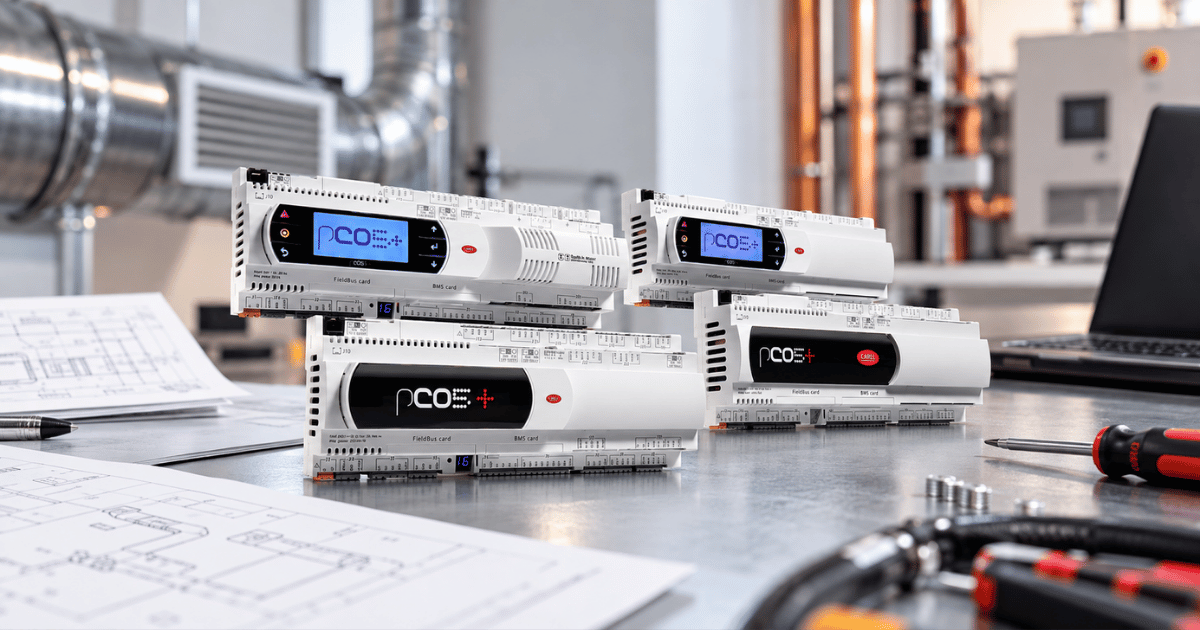
- Programmable controllers — fully configurable units such as Carel's c.pCO range, where the engineer writes the control logic. These are found in AHUs, chillers, and complex multi-zone systems.
- Building management system controllers — the top layer of a hierarchical control system, integrating data from many sub-systems and providing building-wide monitoring and optimisation.
Actuators
Actuators are the muscle of the control system — they receive electrical signals from the controller and convert them into physical movement. In HVAC, there are two primary actuator applications:
- Damper actuators — open and close air dampers in ductwork to control airflow volume and direction. Available as spring return actuator (fail-safe) or non-spring-return.
- Valve actuators — open and close or modulate water control valves to regulate the flow of hot or chilled temperature water through coils and heat exchangers.
Variable Speed Drives (VSDs / Inverters)
Variable speed drives — also called VFDs, inverters, or frequency drives — control the speed of electric motors driving fans and pumps. Rather than running at full speed and throttling output with dampers or valves, a VSD reduces motor speed to match actual demand. This produces very significant energy savings: fan power is proportional to the cube of speed, so reducing speed by 20% cuts energy consumption by nearly 50%.
- ABB's ACH580 series — purpose-built HVAC fan and pump drives, widely used in UK commercial installations.
- Danfoss FC102 — the purpose-built HVAC drive series with built-in BACnet IP and Modbus TCP. See all frequency inverters.
Power Controllers: Thyristors and Solid State Relays
For electric heating elements, infrared heaters, and resistive loads, thyristor power controllers and solid state relays (SSRs) provide smooth, stepless output control without the switching noise and wear associated with contactors. They are common in air handling unit heating stages and humidifier control.
How HVAC Controls Communicate
Modern HVAC controls do not operate in isolation. Sensors, controllers, drives, and field devices need to exchange data. This communication happens over wired buses using standardised protocols. The two dominant protocols in commercial HVAC are BACnet and Modbus.
- BACnet (Building Automation and Control Networks) — developed specifically for building automation. Supports complex object models, alarm management, and scheduling. The most widely used protocol in commercial BMS installations. Available over RS-485 (BACnet MSTP) and Ethernet (BACnet IP).
- Modbus — a simpler, older protocol originally developed for industrial PLCs. Widely supported, very reliable, and easy to implement. Mod bus RTU runs over RS 485 connector; Modbus TCP runs over Ethernet.
- 0–10V and 4–20mA analogue signals — the original HVAC control signal. Simple, reliable, and still very widely used for point-to-point control between a controller's analogue outputs and an actuator or VSD. A USB to RS-485 converter is often needed for commissioning access.
What Is a Building Management System (BMS)?
A Building Management System (BMS) — sometimes called a Building Automation System (BAS) or Building Energy Management System (BEMS) — is a centralised control and monitoring platform that integrates all of a building's HVAC, lighting, access control, and other systems into a single interface.
An HVAC BMS allows facilities managers to monitor energy consumption, set schedules, adjust setpoints across zones, respond to alarms, and generate compliance reports — all from a single C.PCO screen or remotely via web browser. The field devices (sensors, actuators, controllers, drives) communicate with the BMS controller via BACnet, Modbus, or proprietary protocols over a network infrastructure.
For large commercial buildings, healthcare facilities, or data centres where energy use is a significant cost and regulatory compliance is essential, a BMS is not a luxury — it is a necessity.
How to Select HVAC Controls for Your Application
The right controls specification depends on the complexity of the system, the communication infrastructure in place, and the performance requirements of the building. Here is a practical framework:
Step 1: Define the control outputs
What physical devices need to be controlled? List every actuator, VSD, electric heater stage, and humidifier in the system. This defines the number of analogue and digital outputs required from the controller.
Step 2: Define the sensor inputs
What conditions need to be measured? Temperature, humidity, pressure, CO₂, and occupancy sensors each represent an analogue input. Door contacts, overload trips, and manual overrides are digital inputs.
Step 3: Define the communication requirements
Does the system need to integrate with a BMS? If so, what protocol does the BMS use — BACnet or Modbus? The controller must support the same protocol and version.
Step 4: Select the controller
Match the I/O count, protocol support, and application type (parametric or programmable) to your requirements. For straightforward AHU or FCU applications, a parametric controller with standard application software is usually the fastest and most cost-effective solution. For bespoke systems, a programmable controller gives full flexibility.
Step 5: Select sensors and field devices
Select sensors with the correct output type (passive NTC/Pt100 for direct connection to the controller, or active 0–10V/4–20mA for longer cable runs). Match actuator signal types to controller output specifications. Ensure VSDs have the correct communication interface.
Common HVAC Controls Problems and How to Avoid Them
- Hunting (unstable control) — usually caused by incorrect PID parameters. The controller over-corrects and the system oscillates around the setpoint. Solution: commission PID parameters properly; most modern controllers have auto-tune functions.
- Sensor drift — sensors can drift out of calibration over time, especially humidity sensors. Always use a sensor manufacturer's recommended calibration interval and replace sensors that cannot be recalibrated.
- Communication failures — loose RS-485 termination resistors, incorrect Modbus addresses, and IP address conflicts are the most common causes. Always document network topology and test communication before commissioning is signed off.
- Actuator torque mismatch — an actuator with insufficient torque for the valve or damper it is driving will fail to close fully, causing control errors. Always verify closing torque requirements against the actuator rating.
- Wrong signal wiring — connecting a 0–10V output to a 4–20mA input, or vice versa, will produce incorrect control. Always verify signal types at both the controller output and the field device input.
iACS HVAC Controls Range
iACS has been supplying HVAC controls components since 2011, stocking over 6,000 products from the UK’s leading manufacturers. Our range covers every component type in the HVAC control chain. You can Browse All HVAC Controls Products in our store.
- Controllers — Carel c.pCO and Carel IR33 series, programmable and parametric controllers, thermostats and humidistats
- Actuators — Belimo and Siemens damper and valve actuators, spring‑return and non‑spring‑return, modulating and on/off. For deeper technical guidance, see HVAC Actuators: The Complete Guide.
- Sensors — Sontay temperature, humidity, pressure, CO₂, and air quality sensors. Explore sensor selection and best practices in our HVAC Sensors and Measurement Guide.
- Inverters / VSDs — ABB ACH/ACS series, Danfoss FC102 HVAC drives
- Power controllers — thyristor power controllers and solid state relays, single and three phase
- Valves — Belimo, Danfoss, and Siemens 2‑port, 3‑port, and pressure‑independent control valves. For application‑specific selection advice, read HVAC Valves: Selecting the Right Control Valve.
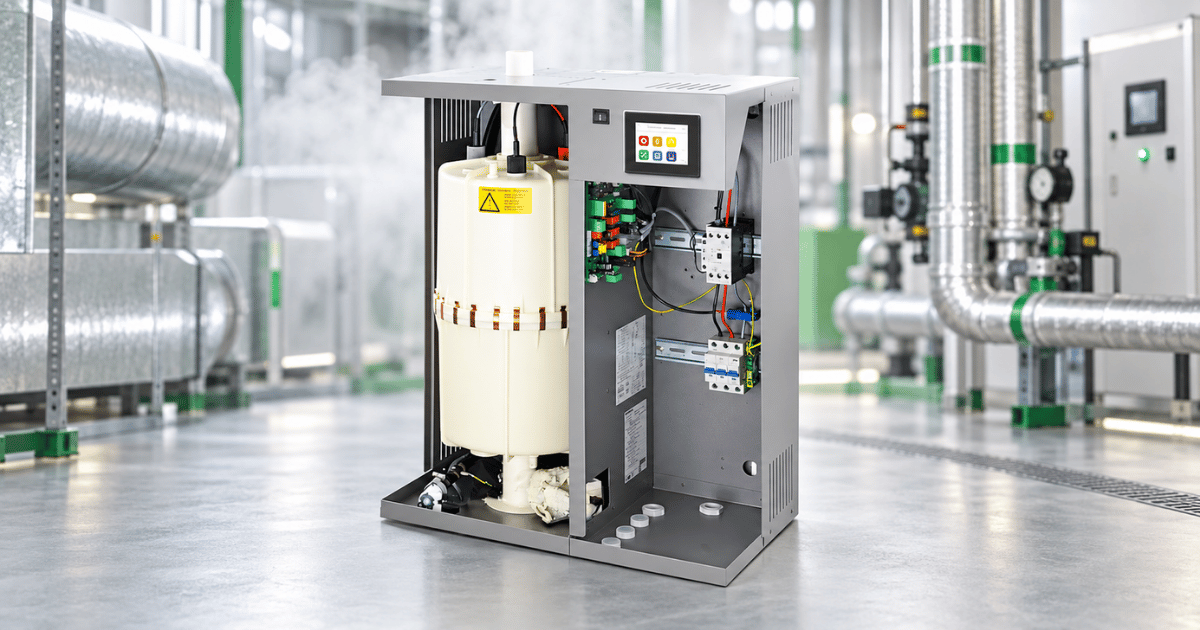
- Humidifiers — Carel steam, Hygromatik and ultrasonic humidifiers, complete with controls and accessories
Frequently Asked Questions
What is the difference between HVAC and HVAC controls?
HVAC refers to the mechanical systems — boilers, chillers, AHUs, fans, pumps, ductwork, and pipework — that heat, cool, ventilate, and humidify a building. HVAC controls are the electronic and software systems that tell those mechanical components what to do and when. You can have HVAC without modern controls (a simple on/off thermostat is a control), but modern buildings use sophisticated digital controls to maximise efficiency and comfort.
What protocol should I use — BACnet or Modbus?
If your system needs to integrate with a BMS and you require alarm management, scheduling, and complex object handling, BACnet is the right choice. If you need a simple, reliable link between a controller and a VSD or energy meter, Modbus is perfectly adequate and easier to implement. Many modern controllers support both. See our detailed BACnet vs Modbus guide for a full comparison.
Can iACS help with controls specification?
Yes. iACS has a technical team with 15+ years of hands-on experience in HVAC controls. We can advise on product selection, compatibility, communication protocols, and commissioning. Call us or use the trade account enquiry form on our website.
What brands does iACS stock for HVAC controls?
Our primary ranges include Carel (controllers and humidifiers), Belimo (actuators and valves), Danfoss (valves and drives), Siemens (actuators and valves), ABB (variable speed drives), and Sontay (sensors). We also stock Dwyer (pressure gauges) and a range of signal converters, I/O modules, and accessories from specialist manufacturers.
Comment(s)
Recent Posts
-
Steam Humidifier Explained: How HygroMatik Humidification Systems Work
 October 16, 2026
 -
Carel Controller Fault Codes Explained: A Troubleshooting Guide
 October 15, 2026
 -
Damper Actuator Not Working? How to Diagnose and Fix Common Faults
 October 2, 2026
 -
VAV Box Explained: How Variable Air Volume Systems Control Airflow
 October 1, 2026
 -
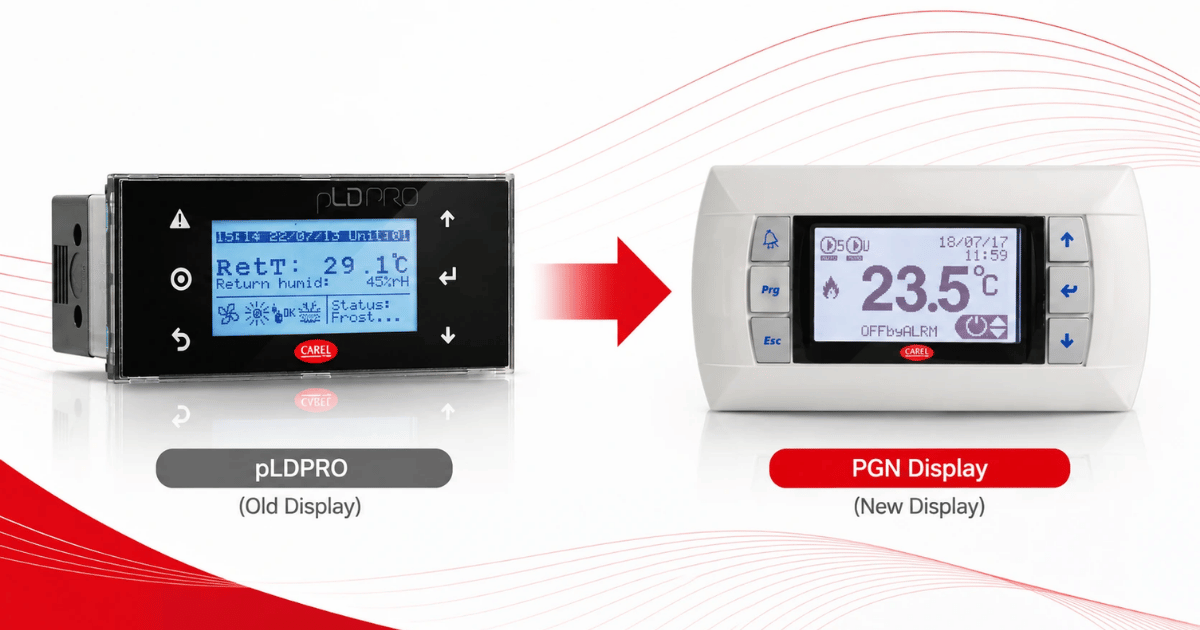
Replacing a CAREL pLDPRO Display: pGDn Options, Fit Checks and Affected Part Numbers
 September 23, 2026