
What Our Customers Are Saying
BACnet vs Modbus: Which Protocol Does Your HVAC System Need?
22
Apr
If you are specifying a new HVAC controls system or integrating new equipment into an existing installation, the choice of communication protocol will define what is possible, what is practical, and what will cost you time on site. BACnet and Modbus are the two protocols you will encounter in almost every commercial HVAC project, and understanding how they fit into the wider control architecture is easier when viewed alongside The Complete Guide to HVAC Controls. This guide explains both clearly, compares them honestly, and tells you which to use when.
What Is Modbus?
Modbus is a serial communication protocol originally developed in 1979 by Modicon for use with programmable logic controllers (PLCs). It is one of the oldest and most widely deployed communication protocols in industrial and building automation, and its longevity is a testament to its simplicity and reliability.
Modbus uses a master/slave architecture. One master device (typically a BMS or a controller) polls one or more slave devices (sensors, drives, controllers) for data. Each slave has a unique address (1–247 for Modbus RTU) and each data point within a device is accessed by register number.
- Modbus RTU — the original serial version, running over RS-485 two-wire bus. Transmission is binary and compact. Up to 32 devices on a single bus segment (247 with repeaters). Half-duplex; only one device transmits at a time. A USB to RS-485 converter is commonly used for commissioning access.
- Modbus TCP — the Ethernet version. Same register-based data model, but transported over TCP/IP. No address limit; integrates directly with IP network infrastructure.
What Is BACnet?
BACnet (Building Automation and Control Networks) is an ANSI/ISO/ASHRAE standard communication protocol developed specifically for building automation systems. Unlike Modbus, which simply exchanges numbers (register values), BACnet uses a rich object model: every piece of data in a BACnet device is represented as an object with a defined type (analogue input, binary output, schedule, alarm, trend log) and a set of properties.
This object model makes BACnet particularly powerful for complex building systems where alarm management, scheduling, trend logging, and inter-device coordination are required.
- BACnet MS/TP — runs over RS485 connectors, similar to the physical layer of Modbus RTU. Uses token-passing rather than master/slave. Common at field device level.
- BACnet IP (BACnet/IP) — runs over a modem to Ethernet/IP. The dominant BACnet variant at the BMS supervisory level. Most modern commercial BMS platforms are BACnet IP.
For a practical overview of how BACnet fits into building automation, our BMS guide provides a clear, engineer‑focused explanation.
Key Differences: BACnet vs Modbus
- Complexity vs Simplicity — MSTP BACnet is more complex to implement and configure, but provides far more capability. Modbus is simpler, easier to troubleshoot, and has lower overhead.
- Data model — BACnet has defined objects for every HVAC data type; Modbus just has numbered registers with values. BACnet is self-describing; Modbus requires an external register map.
- Alarms and events — BACnet has native alarm and event management; Modbus has none — alarms must be handled by the master application.
- Scheduling — BACnet controllers can hold and execute time schedules independently; Modbus devices cannot.
- Interoperability — BACnet's PICS (Protocol Implementation Conformance Statement) and BTL (BACnet Testing Laboratories) certification provide verified interoperability. Modbus has no equivalent certification; implementations vary.
- Hardware support — Modbus is supported by virtually every piece of HVAC equipment made in the last 40 years. BACnet support is more recent and not universal in lower-cost or legacy equipment.
Which Protocol Should You Use?
The answer depends on your application:
- Use BACnet when:
You are specifying a new commercial BMS integration; you need native alarm management, scheduling, and trend logging at the field device level; you are working in a multi-vendor environment with a requirement for verified interoperability; the project requires BREEAM or NABERS certification, which specifies BACnet compliance. - Use Modbus when:
You are integrating a Danfoss VSD or plug in energy meter into a controller without full BMS connectivity; the equipment does not support BACnet; you need a simple, low-cost, easy-to-configure link between two devices; the project is a retrofit where the existing BMS uses Modbus and adding BACnet would require significant infrastructure changes. - Use both when:
(This is very common) — Field devices communicate to local controllers via Modbus, and those HVAC controllers aggregate data and communicate upward to the BMS via BACnet. This tiered architecture is standard practice in large commercial installations.
BACnet and Modbus in iACS Products
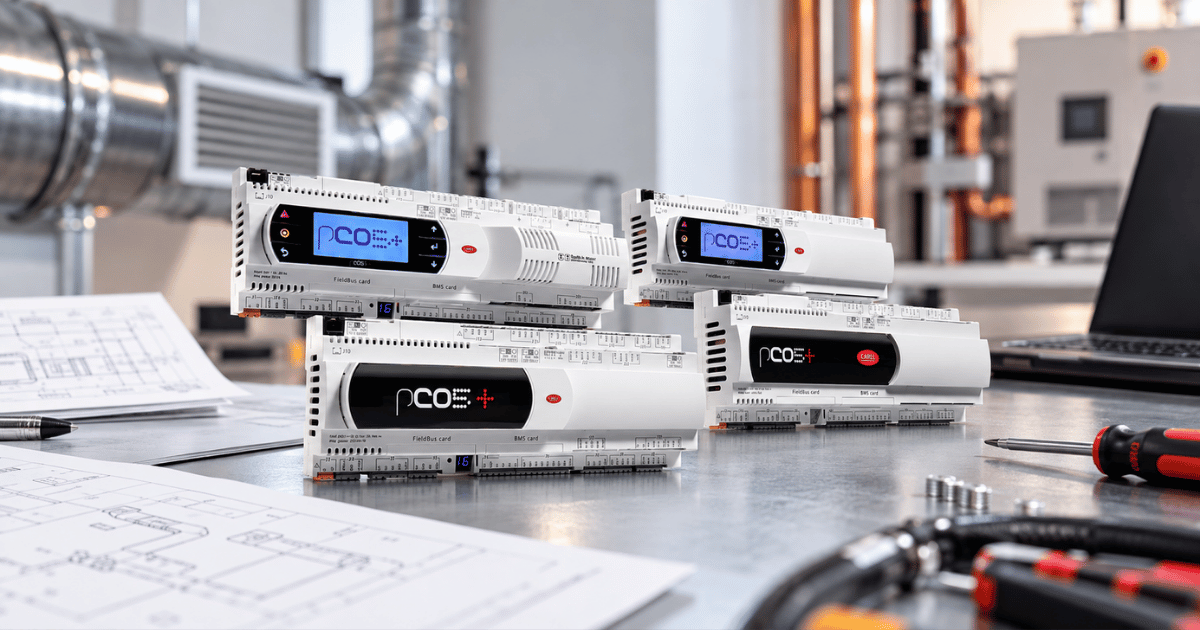
The Carel pCO controller range supports BACnet MS/TP, BACnet IP, Modbus RTU, and Modbus TCP, making it compatible with virtually any BMS platform. If you’re choosing between models, our Carel Controllers Guide breaks down the differences clearly.
The Danfoss FC102 HVAC drive also supports BACnet IP and Modbus TCP natively, and our FC102 technical guide explains its HVAC‑specific features in detail.
Comment(s)
Recent Posts
-
Steam Humidifier Explained: How HygroMatik Humidification Systems Work
 October 16, 2026
 -
Carel Controller Fault Codes Explained: A Troubleshooting Guide
 October 15, 2026
 -
Damper Actuator Not Working? How to Diagnose and Fix Common Faults
 October 2, 2026
 -
VAV Box Explained: How Variable Air Volume Systems Control Airflow
 October 1, 2026
 -
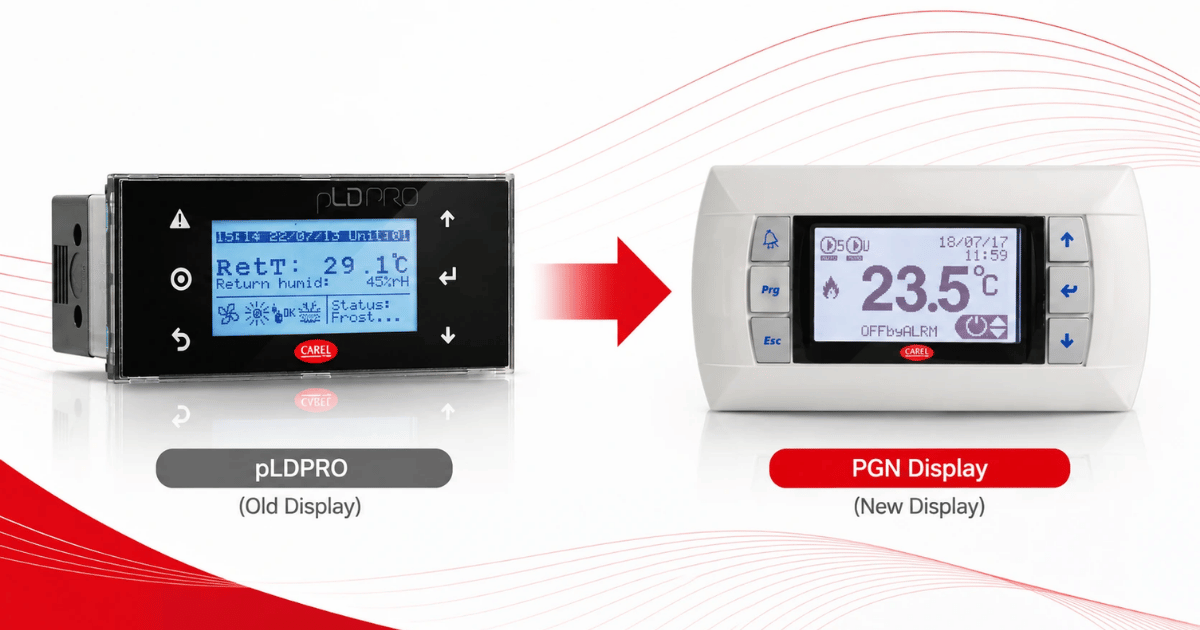
Replacing a CAREL pLDPRO Display: pGDn Options, Fit Checks and Affected Part Numbers
 September 23, 2026