
What Our Customers Are Saying
How to Fault-Find a Siemens SAS61 / SAX61 Actuator
9
Jul
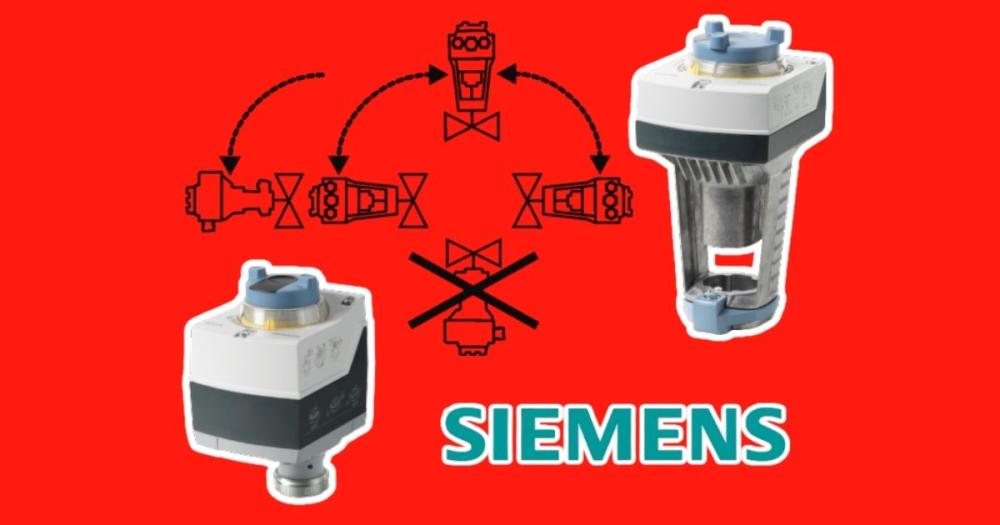
Understanding the Model Numbers
The Siemens SAS and SAX series use a consistent model number structure that tells you the signal type and stroke. Getting this wrong at order stage is the source of the majority of Siemens actuator commissioning issues on UK projects.
For a full foundational overview of HVAC control strategy, see the HVAC Controls Practical Guide.
|
Model |
Stroke |
Signal |
Fits |
Notes |
|---|---|---|---|---|
|
5.5 mm |
3-point floating |
VVF53 DN15–DN32 |
Y1 = open pulse, Y2 = close pulse. No 0–10V. |
|
|
SAS61.73 |
5.5 mm |
0–10V modulating |
VVF53 DN15–DN32 |
Y1 = 0–10V analogue from BMS. Standard for BMS control. |
|
20 mm |
3-point floating |
VXG44 DN25–DN100 |
As SAS61.03, pulse open/close only. |
|
|
SAX61.73 |
20 mm |
0–10V modulating |
VXG44 DN25–DN100 |
Y1 = 0–10V. For BMS 0–10V output. |
|
SQS65 |
5.5 mm |
0–10V modulating |
AB-QM via Siemens M30 adapter |
Also fits Siemens VVF globe valves. |
⚠ The SAS61.03 and SAS61.73 look identical externally. The only way to confirm which you have is the full model number on the label. If the last two digits are .03, it will not respond to a 0–10V BMS output under any circumstances.
Fault Sequence: No Movement
Start with supply voltage: measure 24V AC at terminals G and G0 on the actuator. Siemens SAS and SAX actuators require 24V AC, not DC. Some installation teams use 24V DC transformers without checking this; the actuator will not function on DC supply. Confirm the transformer secondary is 24V AC.
With supply confirmed, check the control signal. On the SAS61.73 (0–10V): measure Y1 to G0. A reading between 0 and 10V DC confirms the BMS is providing a signal. No signal means the fault is in the BMS output module or the signal cable.
On the SAS61.03 (3-point): with the BMS commanding open, measure Y1 to G0, you should see 24V AC pulsing. With BMS commanding close, measure Y2 to G0, 24V AC pulsing. No pulse means the BMS output is not driving the actuator or the cable is broken.
Fault: Actuator Goes to One End-Stop and Stays There
On the SAS61.73: if the BMS is providing a valid 0–10V signal but the actuator drives to fully open and stays there regardless of BMS demand changes, the most likely cause is a wiring error, the actuator is wired to a 24V AC supply on Y1 rather than the 0–10V signal. Measure Y1 to G0: should read 0–10V DC; reading 24V AC confirms incorrect wiring.
On the SAS61.03: driving to one end-stop is normal behaviour if only one of Y1/Y2 is pulsing. Confirm both Y1 and Y2 are wired to BMS digital outputs and that the BMS logic is driving both for open and close commands.
Fault: Actuator Moves But Valve Doesn't
The SAS and SAX series couple directly to the Siemens VVF and VXG valve spindle via a direct push-fit coupling, there is no thread or clip. The actuator must be pressed firmly onto the valve spindle until the coupling clicks into engagement, and the mounting screw must be tightened to secure it. A partially engaged coupling allows the actuator to drive with the valve stem stationary.
For AB-QM PICV applications using the Siemens SQS65 via M30 adapter: confirm the M30 adapter thread is fully engaged on the AB-QM M30 boss and the locking ring is tightened to the specified torque. A loose adapter is the most common SQS65/AB-QM fault.
Fault: Incorrect Stroke or Partial Travel
The SAS61 (5.5 mm stroke) and SAX61 (20 mm stroke) are not interchangeable. Fitting an SAS61 to a VXG44 valve (which requires 20 mm stroke) results in only partial valve travel, approximately 27% of full stroke. The valve will open and close, but will never reach fully open, resulting in under-supply even at full BMS demand. Confirm valve model and actuator stroke match before installation.
Frequently Asked Questions
Q: My SAS61 was working and has now stopped, it hums when commanded but doesn't move.
Internal gear strip, the most common failure mode on SAS61 units in old systems. The motor runs but the gearbox output doesn't turn. Confirm by checking if the manual override (handwheel) moves, if it's stiff or jammed, the gearbox has failed. Replace the actuator.
Q: Can I replace an SAS61.03 with an SAS61.73 without changing BMS wiring?
You need to change the BMS output from 3-point digital to 0–10V analogue. If the BMS controller only has digital outputs, you cannot directly use a 0–10V actuator. Check the BMS controller's output types before specifying the replacement actuator.
Q: Does the SAX61.73 work on 24V DC?
No, the SAS and SAX series require 24V AC. Using DC supply is the most common cause of new Siemens actuators appearing dead on site.
Comment(s)
Recent Posts
-
Steam Humidifier Explained: How HygroMatik Humidification Systems Work
 October 16, 2026
 -
Carel Controller Fault Codes Explained: A Troubleshooting Guide
 October 15, 2026
 -
Damper Actuator Not Working? How to Diagnose and Fix Common Faults
 October 2, 2026
 -
VAV Box Explained: How Variable Air Volume Systems Control Airflow
 October 1, 2026
 -
Replacing a CAREL pLDPRO Display: pGDn Options, Fit Checks and Affected Part Numbers
 September 23, 2026